Selling Antique Mechanical Banks

Sell Your Antique Mechanical Banks Collection

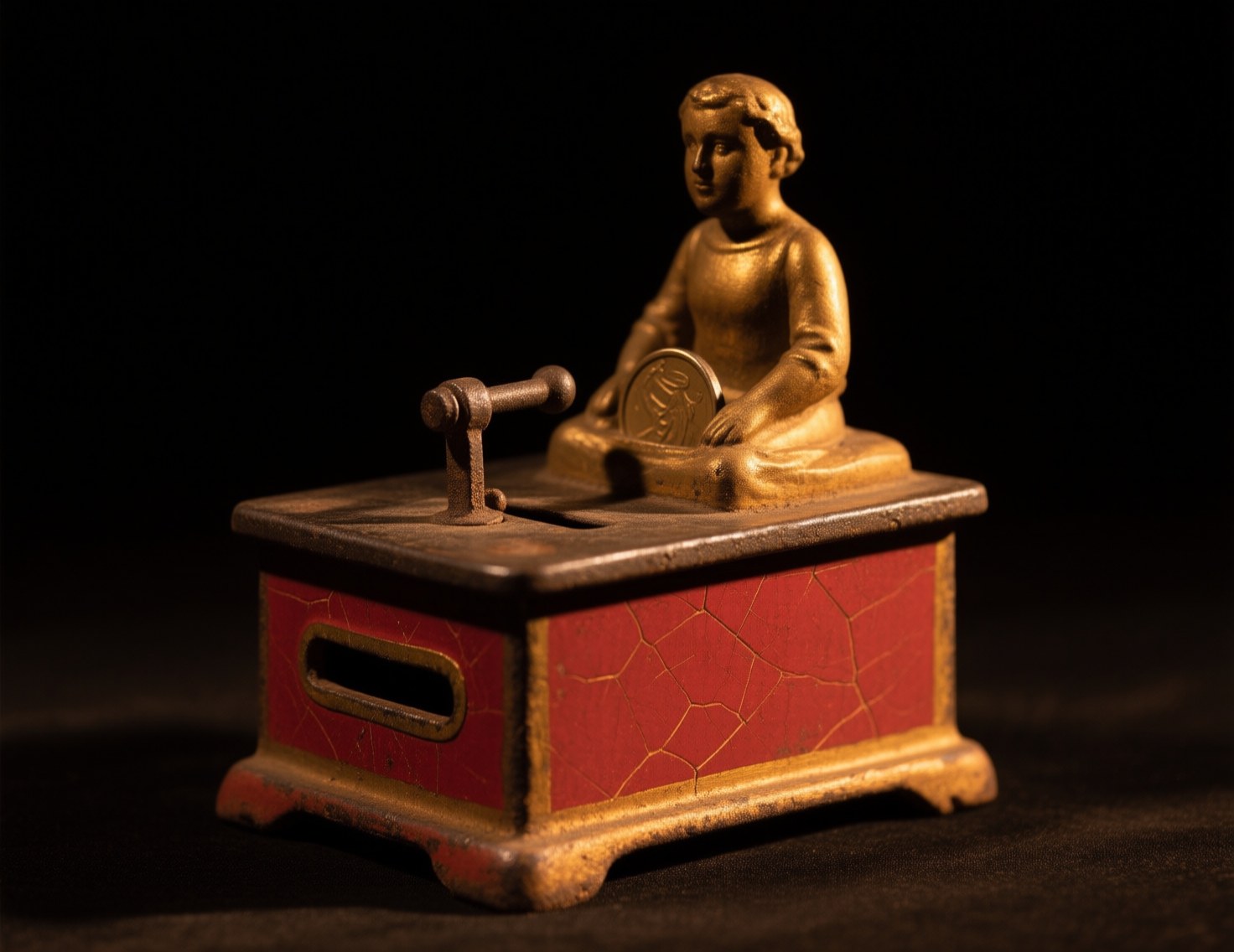
Cast iron banks that perform an action when a coin is placed, made from 1869 through the 1920s. Value turns on the form, original paint, complete working parts, and whether it is a period original.

How we buy Antique Mechanical Banks

Every Antique Mechanical Banks piece is researched by hand, graded straight, and priced against real eBay sold comps. We’d rather quote you a number you can check than a number you have to take on faith.

What makes a Antique Mechanical Banks piece valuable

The era collectors care about: 1869-1928, with 1940s-1950s reproductions as a separate problem. Two pieces that look the same to most buyers can be worlds apart in value. Here’s what we check before we put a number on anything:

The form and its color variation, because a handful of banks are far scarcer than the common ones, and the same bank in a rarer color or table variation can sit in a different market

Original paint, since fine craze lines and glass-hard enamel mark a period finish, while repainted banks and touched-up detail are discounted heavily by collectors

Completeness and a working action, including the original figures, trap, trays, springs and lever for the bank, because a missing or replaced part changes both the action and the value

Whether the bank is a period original, since reproductions made from the late 1940s and in the 1950s copy many popular forms, and a copy is a decorative object rather than a collector's bank

Casting quality and condition, including crisp detail, tight seams, cracks, repairs and rust, where a clean casting and a bank that still works are what collectors pay for

Identify

How to identify genuine Antique Mechanical Banks

  1. 1

    Look closely at the casting. Originals show smooth, sharply detailed castings with tight seams, while many reproductions have soft, indistinct detail, gaping seams and a coarse, pebbly surface.

  2. 2

    Examine the paint. Original paint is glass hard and often shows fine craze lines in deep crevices, with small details such as eyelashes and buttons painted finely. Reproduction paint tends to be thin, in basic colors, and crude.

  3. 3

    Measure the base against a known original. Cast iron shrinks as it cools, so a recast made from an original bank is typically about one-eighth to one-quarter inch shorter along the base, whether it is marked or unmarked.

  4. 4

    Turn the bank over and read what is cast underneath. Marked reproductions say so, and a bank with no mark still has to be judged on casting, paint and size together.

Antique Mechanical Banks — priced on what it really is

Pieces we know well in Antique Mechanical Banks

A few of the Antique Mechanical Banks pieces we research and buy — though we identify and price everything you send, common and scarce alike:

  • Kyser & Rex Mikado bank, red table variation
  • Hall's Excelsior, J. & E. Stevens, patented 1869
  • Hall's Lilliput bank, J. & E. Stevens, patented 1875
  • Teddy and the Bear bank, J. & E. Stevens, about 1907

Selling your Antique Mechanical Banks, step by step

01

Send photos and a few details

Snapshots of your Antique Mechanical Banks pieces — the bank from front, back and both sides, the underside and base, the mechanism set and released, and close-ups of paint wear and cast marks. The line and rough condition is plenty to start.

02

We research and quote

Each piece gets identified by hand, graded straight, and priced against actual Antique Mechanical Banks sold listings — the real sales behind the number.

03

Deal direct, or walk away

Take the offer and get paid, collector to collector — or hold onto your Antique Mechanical Banks. No fees, no pressure, no obligation either way.

Get an honest number on your Antique Mechanical Banks.

Tell us what you’ve got. A real collector reads every message, researches each Antique Mechanical Banks piece against real sold comps, and gets back to you — usually within a day. No obligation.

  • Sold-comp-backed offer, not a lowball
  • Every piece identified by hand
  • No obligation, no pressure to sell

Sell your Antique Mechanical Banks

A few details is all it takes. Photos help, but aren't required to start.

No spam, no list-selling. Just a real reply from a collector.

Selling Antique Mechanical Banks — straight answers

How do you decide what my Antique Mechanical Banks is worth?+

Every number is anchored to real eBay sold listings - what Antique Mechanical Banks pieces in the same condition have actually sold for recently, not active asking prices or an estimate tool. We identify exactly what you have first (1869-1928, with 1940s-1950s reproductions as a separate problem), then pull the comps that match.

What drives the value in Antique Mechanical Banks?+

The form and its color variation, because a handful of banks are far scarcer than the common ones, and the same bank in a rarer color or table variation can sit in a different market. Original paint, since fine craze lines and glass-hard enamel mark a period finish, while repainted banks and touched-up detail are discounted heavily by collectors. We check each of these by hand before we quote, so the offer reflects what your specific pieces are - not a blanket price for the line.

Do I have to sell, or can I just get a number?+

No obligation, ever. Send photos and we'll research each piece and give you an honest, sold-comp-backed read. If you decide to hold, that's completely fine - no pressure, no list-selling.

Will you buy a whole Antique Mechanical Banks collection or just the rare pieces?+

Both. We'll take a collection as a whole or cherry-pick the standout pieces - whichever gets you the best outcome. Either way every item is identified and priced on its own merits, including the common ones.

How do I tell if my mechanical bank is an original or a reproduction?+

Check four things together: crisp casting with tight seams, glass-hard paint with fine craze lines, a base that matches the size of a known original, and any mark cast underneath. Reproductions are often a little shorter along the base because the iron shrinks when recast. Photograph the underside and the paint in raised light, and the bank can be checked against known originals.

Does a repainted bank still have value?+

It has some value, but much less than a bank with its original paint. Collectors want the factory finish, and a repaint hides the casting detail and the age evidence they check. If your bank has chipped or worn paint, do not strip or repaint it, and do not clean it with anything strong, because that removes what an appraisal looks for.

Does the bank need to work for it to be worth selling?+

A working action helps, but it is not the first thing a collector checks. Original paint, complete parts and a period casting matter most. Missing or replaced pieces, such as a figure, a trap or a spring, lower the value even when the action runs. Describe how the bank behaves with a coin and photograph it with the mechanism set and released.

Researching a different line? See everything we buy.

We also buy

Märklin Toy Boats and Ocean Liners1900-1930, tinplate clockwork, spirit-fired and live-steam ships and boats from Göppingen, GermanyMärklin Tinplate Cars, Fire Engines and Carousels1890s-1910s hand-painted tinplate road vehicles, fire engines, carousels and other novelties from Göppingen, GermanyCast Iron Toy Vehicles (Arcade, Hubley, Kenton)1900s-1940s American cast iron cars, trucks, buses and cyclesLehmann Tin Wind-Up Toys1881-1950s German lithographed tin novelty toysJapanese Tin Robots1950s-1960s, with a few earlier clockwork robots and later reissues as separate marketsMärklin Tinplate Trains1891-1930s prewar Gauge 1, 2 and 3 clockwork and live steam; the 1969 Gauge 1 revival is separate