Antique Mechanical Banks Value Guide

Antique Mechanical Banks Value Guide — What’s It Worth?

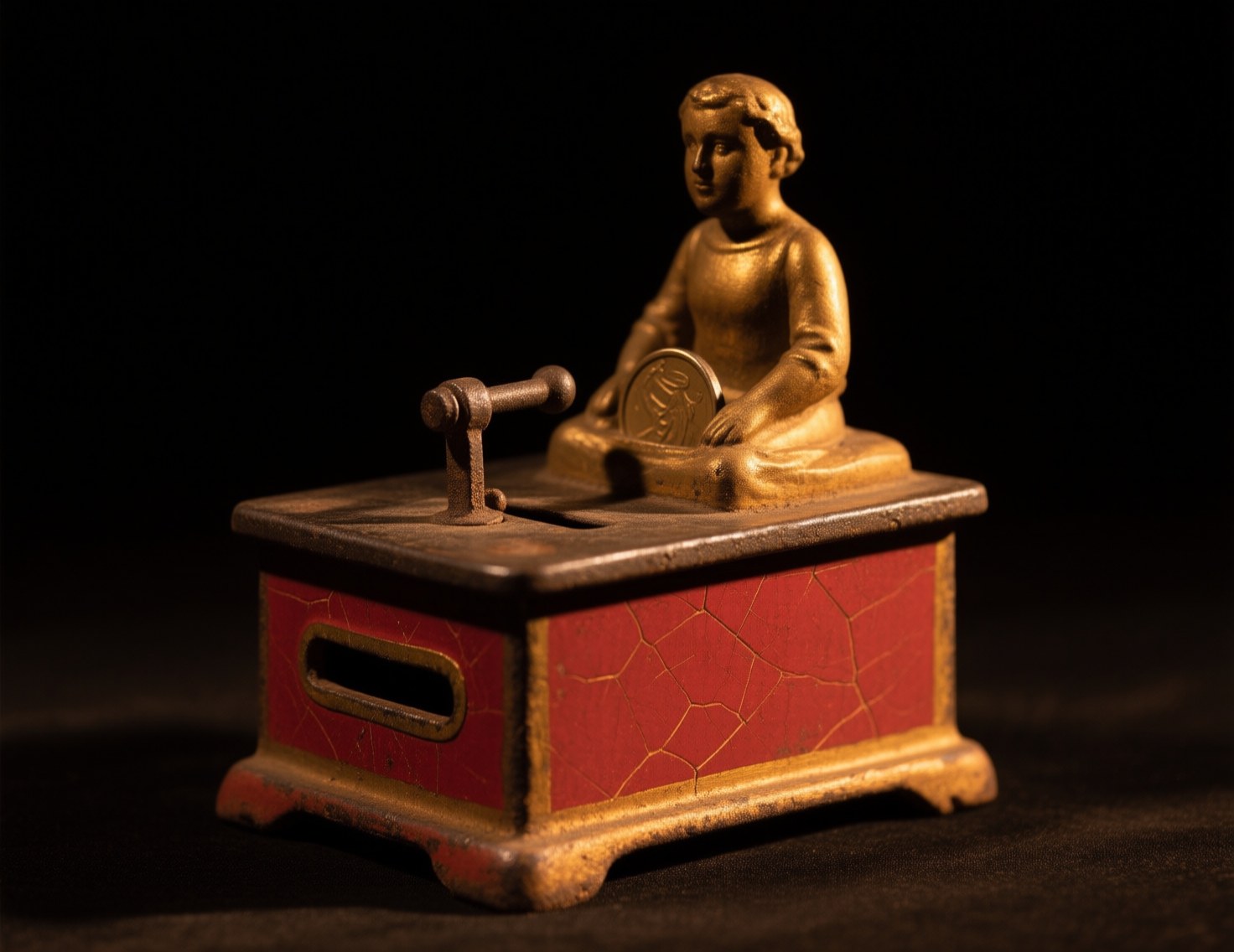
Cast iron banks that perform an action when a coin is placed, made from 1869 through the 1920s. Value turns on the form, original paint, complete working parts, and whether it is a period original.

How we set the number

Prices with a receipt, not a guess

Every Antique Mechanical Banks value we quote is anchored to actual eBay sold listings — the exact prices matching pieces closed at, in matching condition. Active asking prices are wish prices; an automated estimate is a shrug. We start from what people genuinely paid, then adjust for the specifics of your piece.

What drives Antique Mechanical Banks value

The era collectors care about: 1869-1928, with 1940s-1950s reproductions as a separate problem. These are the factors that separate a common piece from a genuine find — and the things to look at before you trust any number:

  1. 1

    The form and its color variation, because a handful of banks are far scarcer than the common ones, and the same bank in a rarer color or table variation can sit in a different market

  2. 2

    Original paint, since fine craze lines and glass-hard enamel mark a period finish, while repainted banks and touched-up detail are discounted heavily by collectors

  3. 3

    Completeness and a working action, including the original figures, trap, trays, springs and lever for the bank, because a missing or replaced part changes both the action and the value

  4. 4

    Whether the bank is a period original, since reproductions made from the late 1940s and in the 1950s copy many popular forms, and a copy is a decorative object rather than a collector's bank

  5. 5

    Casting quality and condition, including crisp detail, tight seams, cracks, repairs and rust, where a clean casting and a bank that still works are what collectors pay for

Antique Mechanical Banks — the details decide the price

Antique Mechanical Banks pieces collectors ask about

Some of the Antique Mechanical Banks pieces whose values come up most often — though every piece is worth identifying, because the value lives in the details:

  • Kyser & Rex Mikado bank, red table variation
  • Hall's Excelsior, J. & E. Stevens, patented 1869
  • Hall's Lilliput bank, J. & E. Stevens, patented 1875
  • Teddy and the Bear bank, J. & E. Stevens, about 1907

The #1 mistake on Antique Mechanical Banks: pricing off a high active listing instead of a real sold one, and assuming condition is better than it is. A clean grade against the sold comps is the difference between a number that holds and a number that disappoints.

History

A short history of Antique Mechanical Banks

The cast iron mechanical bank started in the United States in 1869, when John Hall of Watertown, Massachusetts, patented Hall's Excelsior on December 21 of that year. It is regarded as the earliest patented, commercially manufactured, cast iron mechanical bank, and it was made by J. & E. Stevens of Cromwell, Connecticut. Stevens led the industry, and its mechanical banks continued until about 1928, when the cap pistol crowded them out as a more profitable line. Hall followed the Excelsior with banks such as the Lilliput, patented in 1875. Other firms worked in the same field, including Kyser and Rex, Shepard Hardware of Buffalo, New York, which entered it in about 1882 and sold its bank line to Stevens in 1892, and Hubley of Lancaster, Pennsylvania. Each bank was cast iron, hand painted, and built around a small mechanism that moved a part of the bank when a coin was placed. Collectors value them for the casting detail, the original paint, and the survival of the action. The same appeal led to reproductions, including thirty issued in the 1950s, so authenticity is the first thing to establish.

Identify

How to identify genuine Antique Mechanical Banks

  1. 1

    Look closely at the casting. Originals show smooth, sharply detailed castings with tight seams, while many reproductions have soft, indistinct detail, gaping seams and a coarse, pebbly surface.

  2. 2

    Examine the paint. Original paint is glass hard and often shows fine craze lines in deep crevices, with small details such as eyelashes and buttons painted finely. Reproduction paint tends to be thin, in basic colors, and crude.

  3. 3

    Measure the base against a known original. Cast iron shrinks as it cools, so a recast made from an original bank is typically about one-eighth to one-quarter inch shorter along the base, whether it is marked or unmarked.

  4. 4

    Turn the bank over and read what is cast underneath. Marked reproductions say so, and a bank with no mark still has to be judged on casting, paint and size together.

Reproductions, reissues and fakes to watch for

The Book of Knowledge Collection issued thirty reproductions in the 1950s, and they carry a cast inscription under the base reading 'Reproduced From Original in Collection of The Book of Knowledge', plus a circle impression. The Teddy and the Bear reproduction from about 1957 is shorter on the base than the Stevens original.

About eleven 1950s reproductions are marked underneath as coming from the James D. Capron Collection. They have rough, pebbly surfaces and seams.

Unmarked, high quality reproductions of banks such as Acrobats, Boy on Trapeze, Chimpanzee and Tabby were reportedly made by two men in Pennsylvania in the late 1940s. Their castings are smooth and detailed, so they are harder to spot than the marked ones.

Reproduction paint can fluoresce under ultraviolet light while old paint looks muted, but this test is not foolproof. A reputable collector or dealer should confirm any bank before it is treated as original.

Free appraisal

Get a real number on your Antique Mechanical Banks

Grab the checklist to run a first pass yourself, then send your Antique Mechanical Banks over for a free, no-obligation appraisal — researched by hand and priced against real sold comps.

Free guide

What's My Antique Mechanical Banks Worth?

The same hand-research walk-through we use on every Antique Mechanical Banks piece - boiled down to a checklist you can run yourself. Stop guessing and start with a number you can actually defend.

  • Pin down the exact Antique Mechanical Banks piece - line, variant, and year
  • Grade condition honestly (and dodge the #1 overpricing mistake)
  • Pull real sold comps instead of wishful asking prices
  • Set a number with a receipt behind it

Tell us where to send it and it’s yours — instantly.

Free, instant, and no spam — just the guide.

Want us to value your Antique Mechanical Banks?

Send photos and we’ll do the research — identify each Antique Mechanical Banks piece, pull the matching sold comps, and give you an honest number with the receipts behind it. Free, and no obligation to sell.

  • Anchored to real eBay sold comps
  • Graded straight, every flaw disclosed
  • Free, with no obligation

Appraise my Antique Mechanical Banks

Tell us what you have. Photos help us pull the right comps.

No spam, no list-selling. Just a real reply from a collector.

Antique Mechanical Banks values — straight answers

How is Antique Mechanical Banks value actually determined?+

By real eBay sold listings - the prices Antique Mechanical Banks pieces in matching condition have actually closed at recently, not active asking prices and not an automated estimate. An asking price is a wish; a sold price is a receipt. We start every appraisal from the sold comps.

What makes one Antique Mechanical Banks piece worth far more than another?+

The form and its color variation, because a handful of banks are far scarcer than the common ones, and the same bank in a rarer color or table variation can sit in a different market. Original paint, since fine craze lines and glass-hard enamel mark a period finish, while repainted banks and touched-up detail are discounted heavily by collectors. Two pieces that look identical to a casual buyer can sit at very different numbers once you account for these, which is exactly why a by-hand read beats a price-guide average.

Does condition really change Antique Mechanical Banks values that much?+

Yes - more than almost anything else. Completeness and a working action, including the original figures, trap, trays, springs and lever for the bank, because a missing or replaced part changes both the action and the value. We grade against pristine, not against the last beat-up copy we saw, and when it's a close call we grade down. The honest grade is what keeps the number defensible.

Can I get a real Antique Mechanical Banks appraisal, not just a guide?+

Yes, and it's free with no obligation. Send photos and we'll identify each piece (1869-1928, with 1940s-1950s reproductions as a separate problem), pull the matching sold comps, and give you a number with the receipts behind it. Grab the appraisal checklist below to do a first pass yourself, or send it over and we'll do the research.

How do I tell if my mechanical bank is an original or a reproduction?+

Check four things together: crisp casting with tight seams, glass-hard paint with fine craze lines, a base that matches the size of a known original, and any mark cast underneath. Reproductions are often a little shorter along the base because the iron shrinks when recast. Photograph the underside and the paint in raised light, and the bank can be checked against known originals.

Does a repainted bank still have value?+

It has some value, but much less than a bank with its original paint. Collectors want the factory finish, and a repaint hides the casting detail and the age evidence they check. If your bank has chipped or worn paint, do not strip or repaint it, and do not clean it with anything strong, because that removes what an appraisal looks for.

Does the bank need to work for it to be worth selling?+

A working action helps, but it is not the first thing a collector checks. Original paint, complete parts and a period casting matter most. Missing or replaced pieces, such as a figure, a trap or a spring, lower the value even when the action runs. Describe how the bank behaves with a coin and photograph it with the mechanism set and released.

Looking at a different line? Browse all value guides.

More value guides

Märklin Toy Boats and Ocean Liners1900-1930, tinplate clockwork, spirit-fired and live-steam ships and boats from Göppingen, GermanyMärklin Tinplate Cars, Fire Engines and Carousels1890s-1910s hand-painted tinplate road vehicles, fire engines, carousels and other novelties from Göppingen, GermanyCast Iron Toy Vehicles (Arcade, Hubley, Kenton)1900s-1940s American cast iron cars, trucks, buses and cyclesLehmann Tin Wind-Up Toys1881-1950s German lithographed tin novelty toysJapanese Tin Robots1950s-1960s, with a few earlier clockwork robots and later reissues as separate marketsMärklin Tinplate Trains1891-1930s prewar Gauge 1, 2 and 3 clockwork and live steam; the 1969 Gauge 1 revival is separate